

Language AI for life sciences: fast, compliant communication
Key Takeaways
- Life sciences organizations face rapid growth, tighter timelines, and global expansion, making multilingual, compliant communication mission-critical.
- Language AI helps translate complex scientific, regulatory, and patient content quickly and accurately across markets without sacrificing compliance.
- Industry trends like faster approvals, global trials, and digital patient engagement are driving demand for AI-powered translation and localization.
- Global communication challenges differ by region and sector, so life sciences teams need tailored translation strategies and workflows.
- Hybrid human-plus-AI models, especially MTPE, deliver the quality regulators expect while maintaining operational speed and consistency.
- DeepL's specialized Language AI suite supports end-to-end communication for life sciences teams operating at global scale.
The life sciences industry is undergoing global acceleration, and Language AI is at the heart of it.
The pharmaceutical market alone soared to nearly $1.8 trillion in 2025. Analysts project it to hit $2.8 trillion by 2033. That puts pressure on companies to innovate faster, scale globally, and stay compliant in every language.
But it’s not just about developing the next breakthrough drug. It’s about translating complex science into crystal-clear, regulation-ready, patient-centric communication across dozens of languages and markets.
As DeepL CMO Steve Rotter underscores, “Adaptation isn’t just about removing language barriers. It can transform language into a springboard for growth, as well.”
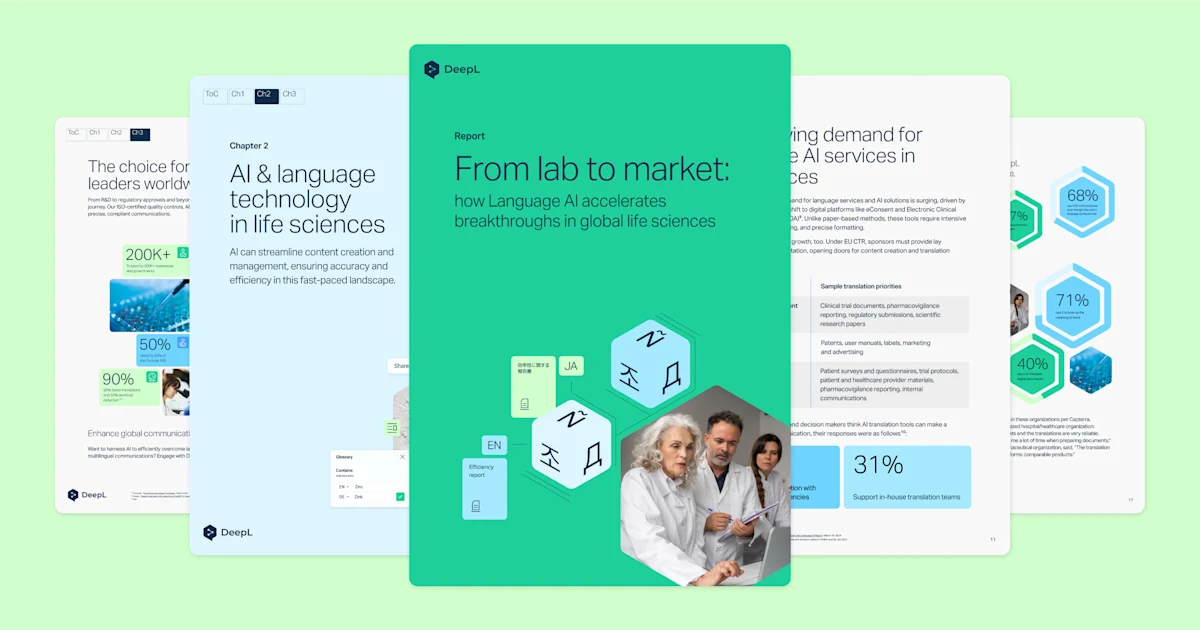
Our white paper explains how life sciences companies are using Language AI to overcome communication and collaboration challenges in a multilingual, highly regulated environment. It highlights AI’s critical roles:
- Breaking down language barriers
- Enabling faster and more accurate translations
- Improving collaboration across global, multilingual teams
That’s why Language AI is booming in life sciences communication and why it’s reshaping how companies work every day.
Why Language AI is booming in life sciences communication
Life sciences companies deal with massive volumes of highly technical, multilingual content. It ranges from clinical trial documentation and patient leaflets to regulatory filings and training materials.
In a world of fast-track approvals, multilingual clinical trials, and digital-first patient engagement, a mistranslation isn't just a typo. It can delay approvals, spark legal action, or risk patient safety.
Enter AI-powered language solutions. This emerging technology category is reshaping how the industry handles translation, enabling faster, more secure, more consistent translations without sacrificing compliance.
The combined market for life sciences language services and technology reached over $80 billion in 2023. And we expect further growth through 2028.
What’s fueling the surge for Language AI translation?
Several major industry trends are driving the need for life sciences language services and technology:
- Faster drug approvals and global clinical trials. Regulatory reforms like the FDA’s digital-first guidance and the EU’s updated clinical trial regulations are shortening timelines but increasing complexity. Language AI helps your teams translate documentation quickly and accurately, reducing time to market.
- Multilingual patient access and engagement. Digital health platforms, eConsent, and public-facing clinical trial summaries require precise communication tailored for different languages and cultures. AI-powered translation solutions help meet these needs efficiently.
- Compliance, accuracy, and risk management. In highly regulated sectors, any misstep in communication, especially across borders, can lead to serious problems. These include legal issues, failed audits, or in the worst cases, patient harm. Specialized Language AI tools help enforce consistency and reduce translation errors.
But these trends also create global communication challenges life sciences teams must solve.
Global communication challenges life sciences teams must solve
Life sciences companies must move fast as regulatory reforms worldwide speed up drug approvals and patient access. They have to do so with accurate translations at the core.
Each global market brings its own linguistic and regulatory challenges. Here’s how that plays out across key regions:
- In the U.S., HIPAA compliance and English-to-Spanish translation dominate.
- Japan and Korea require linguistic nuance and typically prefer human reviewers for critical content.
- In Germany, deep documentation and local vendor preference are the norm.
- France and Spain prioritize cultural adaptation as much as technical accuracy.
- The U.K. deals with the quirks of British vs. American medical English.
Meanwhile, different life sciences sectors, from biotech research to medical device manufacturing, require tailored translation approaches. These depend on content type, volume, and frequency.
Why AI plus human experts works best for life sciences translation
Life sciences companies are increasingly adopting hybrid human-plus-AI translation workflows to meet strict regulatory and linguistic standards without slowing operations.
Machine translation post-editing (MTPE) has emerged as the preferred model. It combines the speed of AI with expert human oversight to ensure scientific and regulatory accuracy.
This human-in-the-loop approach is especially critical in regulated industries, a view global leaders share. According to a 2025 DeepL survey, 31% see AI as key to enhancing in-house translation. Meanwhile, 32% prefer blended solutions that pair AI with human expertise.
As our CTO Sebastian Enderlein highlights, "For high-stakes scenarios like life sciences, our human-in-the-loop approach ensures best-in-class quality, avoiding costly mistranslations."
How life sciences teams are already using DeepL's specialized Language AI
A human-in-the-loop approach best serves life sciences companies’ needs when paired with specialized Language AI, like DeepL. Specialized Language AI features tools like custom glossaries and ISO-certified workflows that ensure greater accuracy and data security.
Here, Sebastian emphasizes, “DeepL’s specialized translation models perform one job exceptionally well: translating text across languages while respecting context and company-specific nuances.”
People across the life sciences industry are already realizing the value of DeepL. Here’s what we found when analyzing DeepL usage in pharma, medical device, and healthcare sectors:
- 68% use DeepL for work purposes, even though they aren’t language professionals.
- 47% use it several times per week.
Let’s get more specific on that usage:
- 71% use DeepL to look up the meaning of words.
- 61% use it to translate emails or messages.
- 54% use it for help writing emails.
- 40% use it to translate digital documents.
That versatility makes DeepL a smart, secure choice for life sciences companies navigating global markets.
More than 200,000 global enterprises trust DeepL for their translation needs: Read their stories.
Learn Language AI strategies for compliant life sciences communication
Life sciences companies can’t afford to treat translation as an afterthought. Language AI is a critical enabler of speed, compliance, and patient trust in a high-stakes, multilingual, highly regulated industry.
Download our white paper for deep insights into critical Language AI factors:
- Tailoring translation strategies. Discover how translation needs vary by market, segment, and use case and why precision is nonnegotiable.
- Leveraging AI without the risk. See how cutting-edge AI, including LLMs and DeepL, enhance translation speed while keeping human experts in the loop for accuracy.
Overall, these factors show that language is now core infrastructure for life sciences, not an optional support service.
From there, it's about choosing Language AI tools that match your workflows, risk profile, and growth plans.
Explore DeepL Language AI for life sciences
When your science moves fast, your communication needs to keep pace with accuracy and compliance.
DeepL's Language AI suite—Translator, Write, Voice, API, and Integrations—gives life sciences teams the tools to translate, communicate, and collaborate accurately across every language and workflow.
Contact Sales to see our Language AI tools in action. We’ll help you find what best fits your life sciences operations.
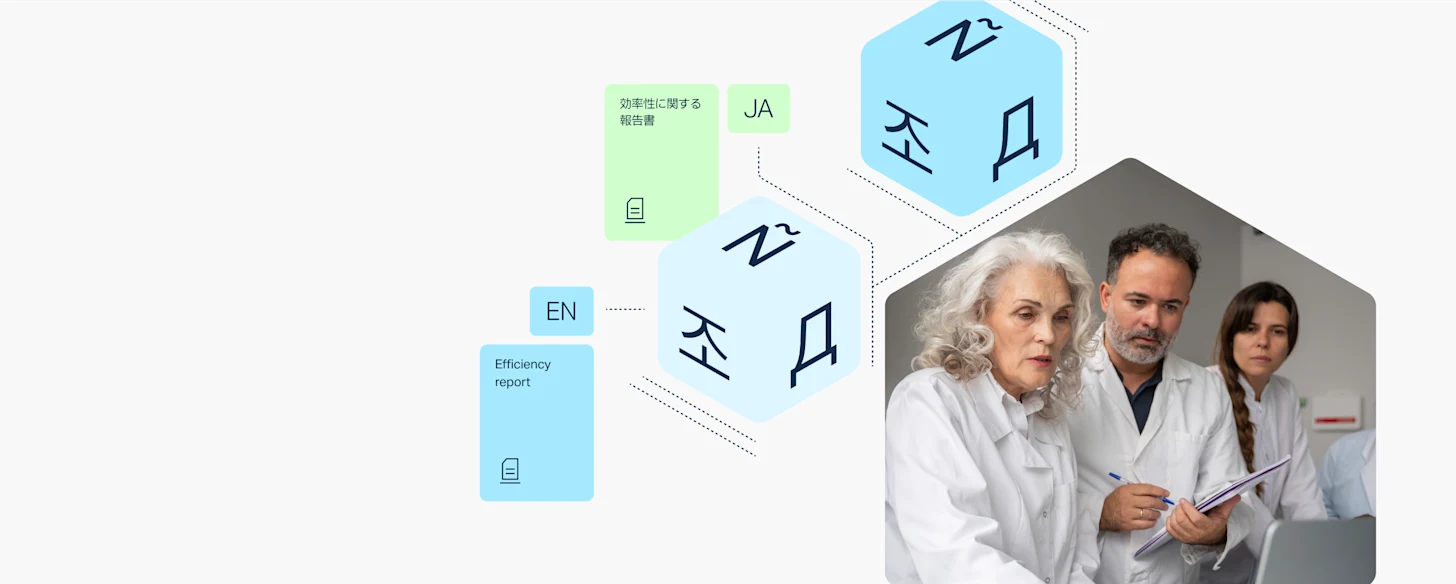
From lab to market: how Language AI accelerates breakthroughs in life sciences
Learn how to harness specialized AI for faster time-to-market, better translation accuracy and consistency, and improved global compliance and patient engagement.