

How we launched over 70 new languages on DeepL
In November last year, we more than tripled the number of languages available on DeepL, launching more than 70 new languages simultaneously. A transformation like this isn’t just a challenge for one team. It’s a company-wide mission that can only succeed through the combined efforts of researchers, software engineers, product designers, program managers and more. It involved close collaboration on innovation and problem-solving across our organization.
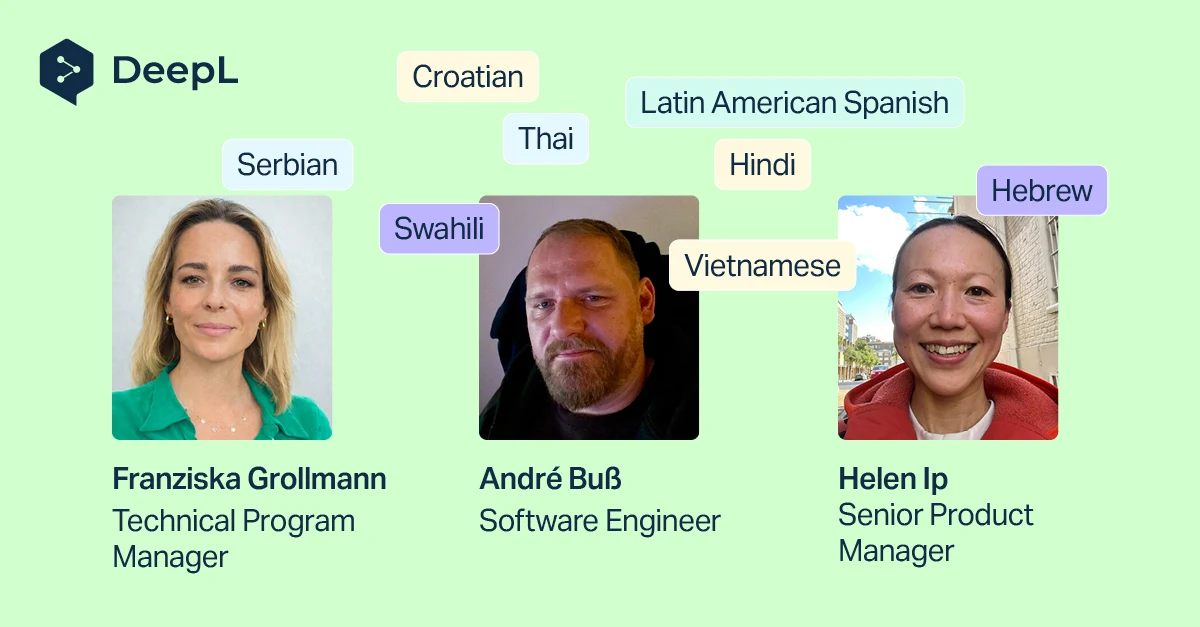
Three of the many, many people involved were Technical Program Manager Franziska Grollmann; Software Engineer André Buß; and Senior Product Manager Helen Ip. We’ve asked them to tell the story of getting DeepL to over 100 languages, and how newly integrated ways of working will enable even faster innovation in 2026.
Making language expansion a strategic priority
Franziska: “A lot of the impetus for adding new languages came from our customer-facing teams, who identified a key strategic need around the languages that our customers asked for most often, and which were business-critical for us. To deliver these, we needed to get everyone on the same page, from Research to Marketing to Sales. My role was to help that process and ensure an end-to-end flow for the project.”
We had a starting list of about 30 business-critical new languages that we brought to our research teams. Our researchers then came back to us and suggested an approach that could add even more languages than we’d requested, leading to over 70 new languages.”
André: “At the end of the day, our motto is breaking down language barriers. If we have the opportunity to extend the number of languages we offer, and make DeepL work for a broader range of people across the world, why wouldn’t we take it?”
Franziska: “Having our different teams work together to broaden the scope of what was possible: that was a real positive for us. It’s typical of the company-wide, integrated approach that we want to take to innovation.”
A new approach to scaling languages with LLMs
Franziska: “In order to make the expansion possible, the research team adapted their approach. This involved creating one model that could work across languages, and which would enable us to add languages at scale, in a way that wasn’t possible previously. That was the real game-changer for our idea of having over 100 languages available on DeepL.”
André: “In the past, we've created dedicated models for each language pair. Having this option of creating one model for multiple languages gives us many more capabilities and opportunities for impact. It means that we can adapt and choose the right approach based on what’s required for each language.”
Franziska: “Once we knew what we could achieve with our new model, the task was to identify the sweet spot for each market between the languages that we needed to prioritize, and the resources required to deliver them. Bringing together perspectives from Research, Marketing, and Sales helped hugely with this. We could identify opportunities among languages that were similar to those we were already prioritizing. We could also accommodate languages with a large volume of speakers and therefore a lot of training data available. This helped with our impact overall.”
Adapting the user experience for 100+ languages on DeepL
Helen: “Although we were adding a lot of languages, we were also very aware that our existing languages are still the ones that most of our users are looking for. We needed to ensure that they could still find those languages quickly.
We did this by iterating and experimenting with our dropdown language selector. We added a favorites section with the language pairs that you use every day, and the language selector also now remembers the language you chose in your previous session. Small adjustments like this ensure that people can still get things done quickly, and that we’re providing the best possible experience to help them stay productive.”
Pushing the capabilities of language detection
Helen: “Our language detection model is something that users don’t really see, but it plays a huge role in their experience of DeepL. When someone types or pastes in text, the model detects the language automatically so that they don’t have to select it manually. That gets more valuable the more languages there are to choose from.
For language detection, the big challenge in moving to over 100 languages is how similar some of those languages now are to one another. We had to ensure that our language detection still performed as strongly. The research team developed a new language detection model, and we tested different parameters and weights within the model for accuracy.”
Launching 70+ new languages across formats and platforms
André: “At the start of 2025, we completed the roll-out of a new technical infrastructure, which was an important foundation in enabling feature parity across our DeepL platforms when we launched our new languages.
In the past, we’ve needed to introduce new features on the web platform first, and then have them trickle down to other platforms like document translation, mobile apps or the API. Every platform needed to implement its own business logic for communicating with the new models, in order to deliver translation results. The new technical infrastructure acts as a backend for all of the different platforms, handling this connection to the downstream services.
This made things a lot easier. It meant that, as soon as research gave us the green light that the preliminary models were ready, we could start testing them on all of the different platforms.”
Helen: “Testing takes different forms for different platforms, because there are different things to watch out for. With document translation, you need to ensure the layout is consistent with the document that you upload, even if you’re translating from a left to right language into one that’s right to left. All of that needs to be taken into account.”
Franziska: “It was very important for us to avoid awkward, disconnected experiences for users. We didn’t want languages to be available for text translation, say, but not for document translation or any other platforms that people wanted to use. The way that our teams worked in parallel meant that we could launch across all of our different platforms in a few days, rather than taking months to fully roll out the new languages.”
Accelerating future innovation
André: “I’ve been with DeepL for more than three years, and you sometimes take it for granted that you’re working with some of the smartest people that you’ve ever worked with. Everyone is very strong in their field, and that makes projects like this, where you work with many different teams, so much fun. The early planning connecting all of the different elements was really important. That type of co-ordination is going to really accelerate these large, exciting projects in the future.”