

How to choose the best machine translation tool for your business
Key Takeaways
- Choosing the right machine translation tool is critical to a strong localization strategy, especially as 87% of marketers report multilingual content as costly and difficult.
- Document format handling, data security, and API offerings are the top considerations marketers weigh when selecting a machine translation tool.
- Data security considerations include encryption, ISO 27001-certified data centers, and GDPR compliance.
- Most marketers work with a technology partner or agency rather than contracting directly with a machine translation vendor.
- Working directly with a vendor offers greater control and cost efficiency compared to going through a partner or agency.
- DeepL's Language AI suite—Translator, Write, Voice, and API—gives businesses flexibility to fit their existing localization workflows.
How many languages does your company operate in? Probably quite a few. As the global marketplace becomes increasingly interlinked, communicating in multiple languages is a necessity for businesses to thrive.
This is where translation and localization come in, allowing companies to authentically connect.
However, 87% of marketers from a 2024 DeepL study stated that having to translate content into multiple languages can be both costly and difficult.
Cue machine translation. It makes a big difference by offering an accurate, efficient, and cost-effective method to localize companies' content.
But choosing the right machine translation vendor isn’t a decision to take lightly. That choice can have a significant impact on your company's localization strategy and overall workflow.
Here, we’ll explore some key considerations when selecting the best machine translation tool for your organization. Remember: With the right choice, your business benefits not only from accurate translations but also from a seamless, secure, and efficient localization process.
Read The Total Economic Impact of DeepL, a Forrester report.
What should you consider when choosing a machine translation tool?
With the help of Regina Corso Consulting, DeepL conducted a survey of marketers in the United States, France, Germany, and Japan. The study specifically targeted those responsible for translation and localization.
With the results of this survey, we created the report: The state of translation and localization in 2023–2024: insights, challenges, and opportunities (access via prg.ai).
Thanks to this research, we discovered a host of helpful insights. For example, 75% of respondents agreed that localized content significantly boosts customer engagement. A staggering 96% reported positive return on investment (ROI) from localization efforts.
Clearly, localization has a significant business impact—meaning selecting the right machine translation tool is critical. According to our research, these are three of the most important considerations.
1. Document format handling
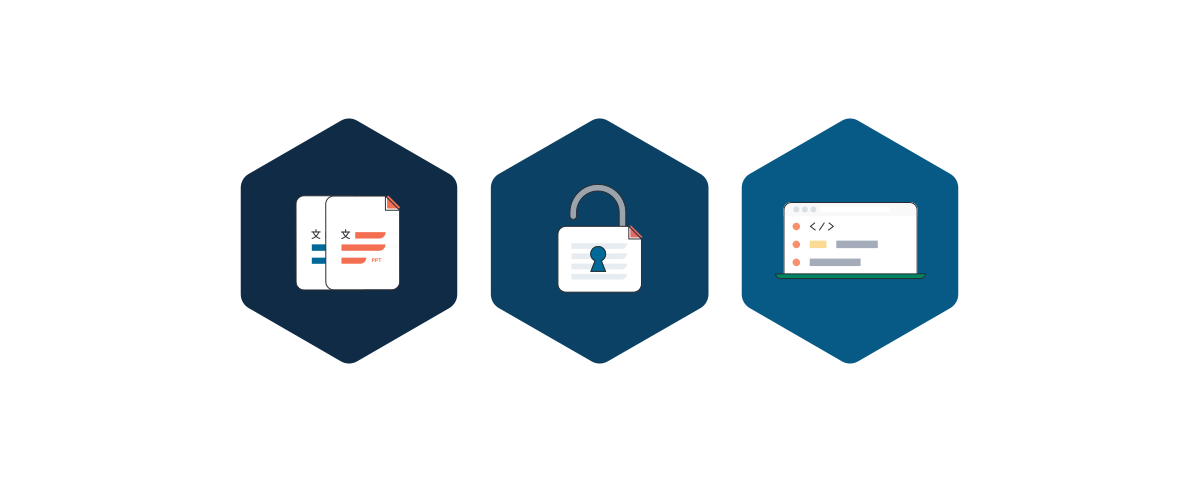
About 23% of respondents noted the importance of a vendor's ability to handle various document formats. These include XML and HTML, among many more.
2. Data security
Around 20% of respondents highlighted the critical role data security plays in the selection process. How companies ensure the protection and privacy of their and their customers' sensitive information is important.
Think along the lines of data encryption, ISO 27001-certified data centers, and GDPR regulations.
3. API offerings
Of the marketers surveyed, 20% indicated the availability of an application programming interface (API) is an important consideration.
After all, APIs are ideal for integrating translation services into existing workflows, streamlining operations, and improving efficiency.
The tech industry distinction
Interestingly, 80% of respondents worked in the technology industry. This may indicate that tech companies’ specific needs affect the importance of these considerations.
In tech, document translation, data security, and API availability play significant roles.
Discover the new DeepL API experience, with more control and more capabilities.
How are companies working with machine translation vendors?
There’s more than one way to work with—and benefit from—a machine translation tool. Our survey revealed three different approaches that marketers are using to work with machine translation vendors:
- 44% work with a technology partner that uses the vendor.
- 33% partner with an agency that employs the vendor's services.
- 23% contract directly with the vendor.
Visit the DeepL Customization Hub, an AI control layer for always on-brand translations.
Technology partner vs. direct vendor: which is right for you?
Our findings about the use of machine translation suggest a trend toward collaboration, with most marketers opting to team up with experts. With this in mind, businesses should consider the benefits of using a technology partner/agency versus contracting directly with a machine translation vendor.
On the one hand, opting for a technology partner or agency allows your company to benefit from its expertise and existing vendor relationships.
On the other hand, working directly with vendors is a better choice when you need greater control over the translation process and a more cost-effective solution.
DeepL is an ideal choice for the latter option. Our accurate, efficient AI translations help streamline the localization process.
Try DeepL Translator for free in your browser.
Find a machine translation tool built for your business
The right vendor both translates and fits how your team already works. DeepL's Language AI suite gives you that flexibility:
- Translator for accurate, secure document translation
- Write for polished multilingual content
- Voice for real-time spoken translation
- API for integrating directly into your existing systems and workflows
Contact Sales to see which specialized Language AI tools fit your localization strategy best.
Want to go deeper? Read "The state of translation and localization in 2023–2024" report via prg.ai, a Prague-based nonprofit focused on AI education. You’ll uncover best practices and learn how AI translation tools play a role in successful enterprise localization.