Real-time, voice-to-voice translation is here, and it’s ready to transform global business
Try to imagine all of the ways in which in-the-moment, spoken human communication shapes the success of your business. Think of all the conversations where instant understanding really matters. From senior-level global meetings to regional planning, factory-floor safety briefings, and urgent customer support calls.
When everybody shares a preferred language, these moments are taken for granted. When they don’t, everything changes. Language friction proliferates at the points where it can do the greatest damage.
Take away people’s ability to communicate meaning instantly through speech, and you quickly undermine their ability to form shared understanding. Colleagues hold back, stay quiet, don’t ask vital questions, and don’t share crucial insights.
This has consequences everywhere: from planning strategy, through to co-ordinating product launches, managing supply chains, and your ability to deliver a world-class customer experience. When people don’t feel heard and understood, frustrations quickly build. Costs escalate, customer loyalty drains away, dangerous misunderstandings mount up.
The complexity of speech means that translation for spoken language, in the moment, is one of the greatest challenges for AI research. The importance of those moments means that it’s also one of the most worthwhile. And solving for real-time speech translation is exactly what DeepL has just done.
Voice-to-voice and more: DeepL Voice’s breakthrough new features
At DeepL Spring Launch, we unveiled the breakthroughs that take real-time speech translation to the next level, and eliminate one of the most significant sources of language-related friction for any business operating globally:
- We’re bringing real-time, voice-to-voice translations to every DeepL Voice solution for every kind of conversation, including virtual meetings with Voice for Meetings. It’s a breakthrough that ensures instant understanding, natural conversation flow, and inclusive experiences where everyone participates in their preferred language. Your colleagues speak and you understand, just as if they were speaking your choice of language.
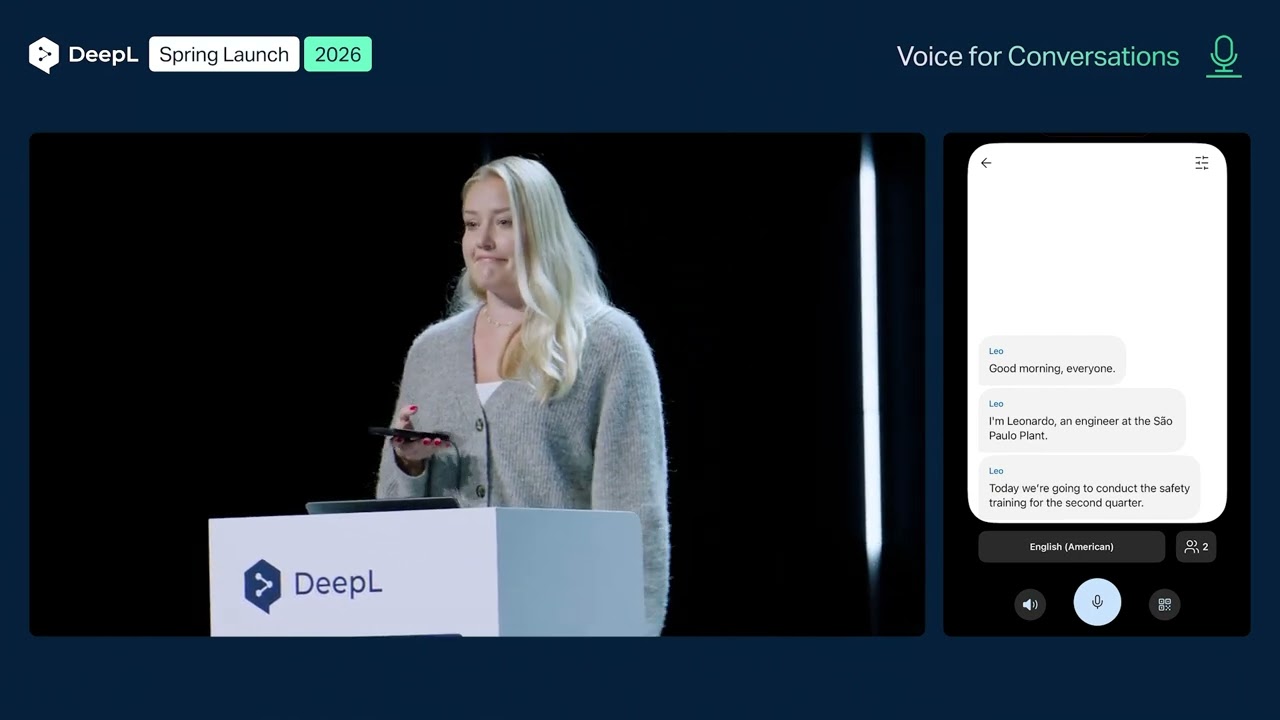
- We’ve launched Group Conversations for DeepL Voice for Conversations, so that multilingual in-person conversations can now take place for groups of any size, in as many languages as they need to, simultaneously. It’s transformative for frontline workers, group training, important safety briefings and more.
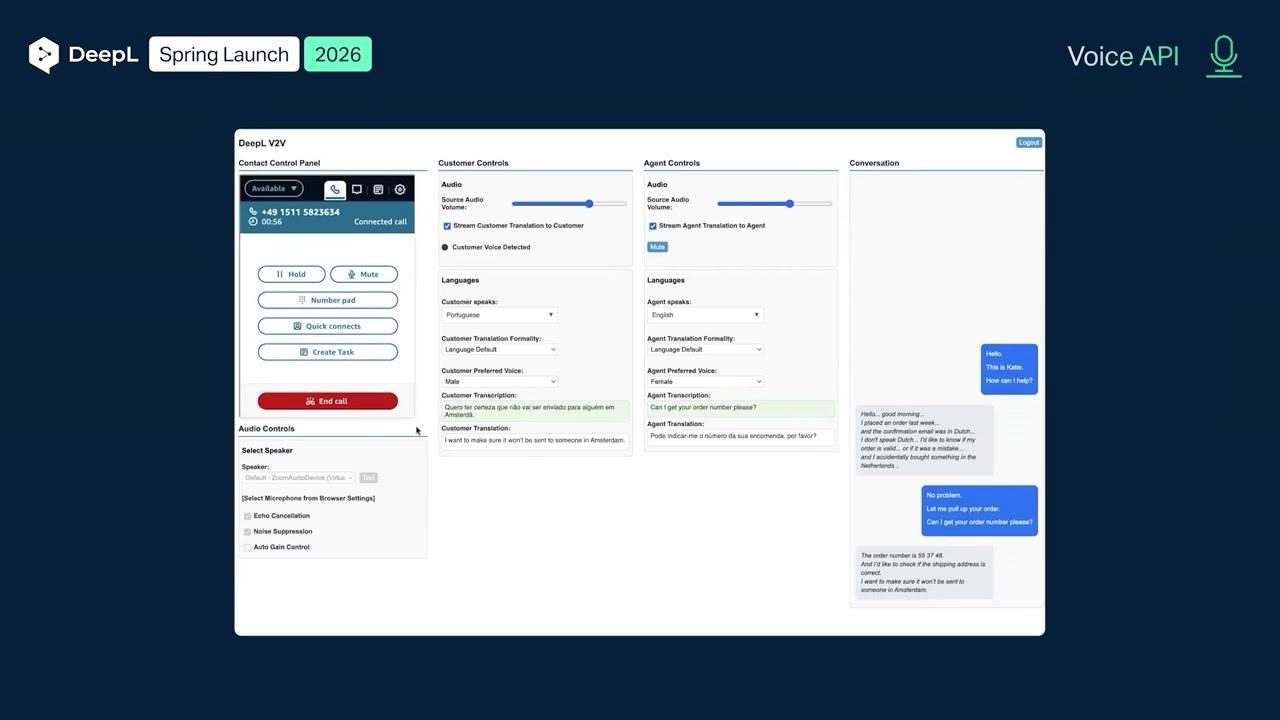
- We’re embedding real-time voice translation and our breakthrough voice-to-voice solution within customer support systems and other platforms through DeepL Voice API. Builders and developers can now embed the most advanced and accurate voice translations into their own platforms, products, and workflows. You can ensure in-the-moment understanding wherever and whenever it’s needed.
Founded in AI research: What it takes to deliver voice translation that works
Real-time voice translation that works for every participant isn’t an application-layer solution that any business can launch. The experience depends on the most precise translations of words, meaning, intention, and tone. It depends on deep language intelligence that enables AI to derive the likely meaning of a sentence, with confidence, while it’s still being spoken. It requires a language platform that understands and conveys the tone and rhythm of every language that people speak, and the slang phrases and familiar constructions that characterize speech as distinct from written text.
DeepL Voice is uniquely capable of delivering this level of applied precision in spoken language, and ensuring that real-time speech translation delivers a seamless, natural experience as both translated captions and real-time voice translation.
The Slator assessment: DeepL is the clear leader on voice translation
Just this month, the language intelligence business Slator released a detailed market assessment of AI translated captions for real-time voice translation. It compared DeepL Voice translations to those generated by Google, Zoom and Microsoft Teams.
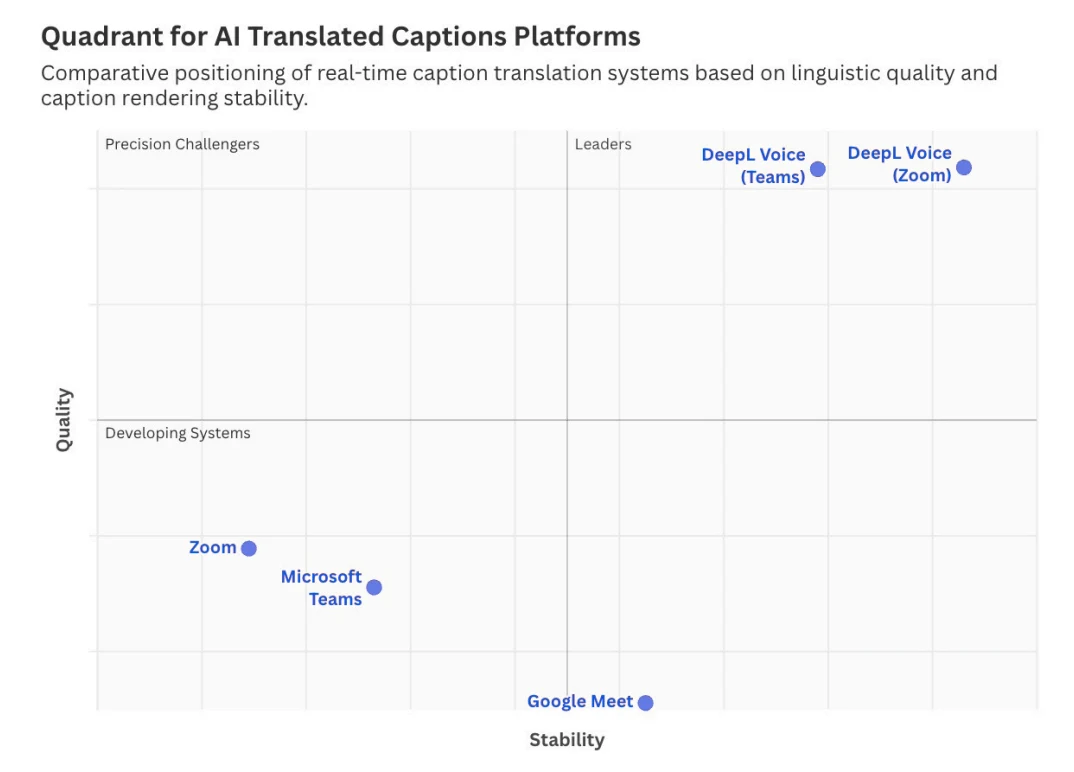
Slator asked professional linguists to rate the translated captions according to two crucial characteristics: quality and stability. DeepL was a clear winner on both criteria by a big margin. In fact, 96% of linguists chose DeepL Voice as their preferred voice translation solution.
It’s a clear demonstration of the DeepL Voice difference, because both of these criteria are hugely important to the effectiveness of voice-to-voice translations.
Quality matters for obvious reasons. DeepL Voice beats competitor voice translations on its ability to capture meaning precisely, and also its reflection of the tone and style of what people were saying.
Stability is crucial for real-time voice translation too. As Slator puts it in the report, “frequent caption updates, partial rewrites, or oscillating translations can negatively affect comprehension, even when the final translation is accurate.” DeepL Voice’s advanced language understanding means that these oscillations occur far less frequently. We call these distracting oscillations “flickering”, and DeepL Voice performs best in this regard.
The massive difference that real-time voice translation makes
DeepL’s commitment to cutting-edge AI research that pushes the boundaries of language understanding has earned the right to make multilingual voice conversations a reality. And that reality makes an instant difference.
Take Aramark and Avendra International. The global hospitality business found that virtual, international meetings routinely lasted 50% longer than they were scheduled for, with overruns that impacted hugely on productivity. Even with this extra time, colleagues who didn’t speak English as a preferred language struggled to contribute. Their valued perspectives were missed. DeepL Voice for Meetings instantly transformed the experience. Painful conversations became instantly inclusive. Natural flow returned. Energy levels escalated. Collaboration became properly inclusive.
Embedding real-time voice translations in customer support systems through DeepL Voice API transforms time to resolution. At the same time, it enhances the customer experience and brings new levels of efficiency and productivity. Customer service teams no longer have to plan around hiring and deploying for language coverage. They can prioritize the resolution skills that really matter and deploy them from everywhere, globally.
Important safety briefings on the factory floor no longer depend on having expensive interpreters on-hand to translate into every language that employees use. No matter the size or language diversity, everyone follows at the same pace, understanding at the same time. Important questions get asked. Managers know when they’re being properly understood.
Making real-time voice translation a reality is one of the most exciting achievements I’ve seen in my time at DeepL. It’s exciting for our business. It’s even more exciting for every business we work with. And it’s ready to start eliminating friction and transforming collaboration for your teams today, as we continue to work on creating a truly borderless world.