Decoding Trust in Enterprise Language AI . In conversation with Slator

在本博文中
- 1. Accuracy trust: the one everyone asks, the one that matters least
- 2. Consistency trust: the regulated buyer's real problem
- 3. Security trust: the question that kills deals in InfoSec review
- 4. Scale trust: "it works in the demo" is not a guarantee
- 5. Outcome trust: the requirement most buyers skip entirely
- Watch the full episode!
Every RFP in the language tech space has a "trust question" and every vendor tries to answer it well. Six months into production, something breaks. The data is in the wrong jurisdiction, the output shifted after a model update nobody mentioned, the cost is three times the projection. The word didn't fail you. The word "trust" or "quality" meant something different to every person in the room.
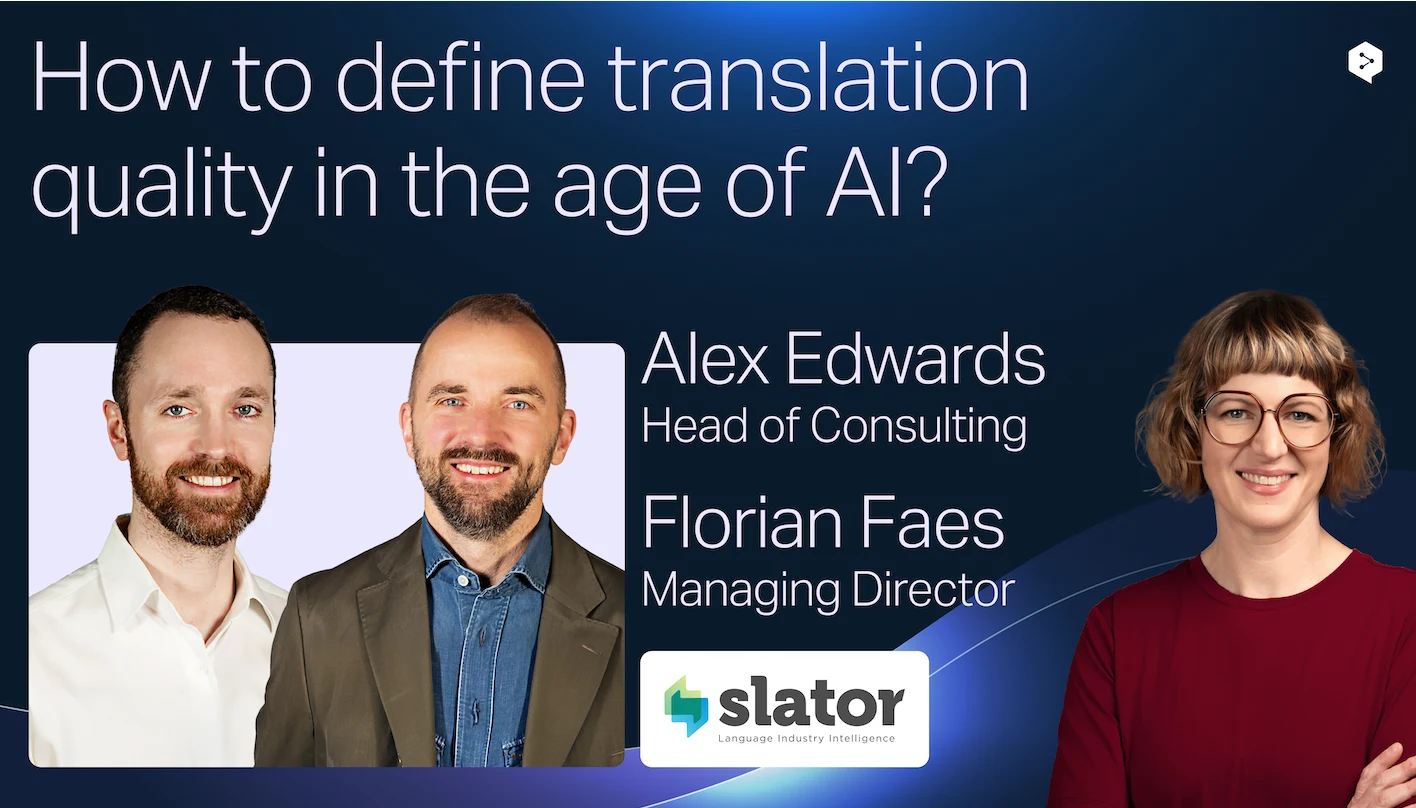
In a recent episode of "The New Fluency" podcast, Slator's Managing Director Florian Faes and Head of Consulting Alex Edwards walked through what enterprise buyers actually mean when they say "trust".
1. Accuracy trust: the one everyone asks, the one that matters least
Accuracy is where every trust conversation starts. And it's the least useful place to spend time, because the baseline has already moved.
"Four years ago it was always like, oh, this was done by AI. It's got to have a mistake 100%," Florian said. "The general trust in the output of AI has increased dramatically. People just trust AI more broadly, meaning they also trust AI translation much more broadly."
The question is whether the AI output is accurate enough for specific use case. A pharmaceutical label, a user-generated product review, and an internal FYI summary - each require a different ceiling.
Buyers who don't specify content class end up over-engineering quality for low-stakes content and under-specifying it where it actually matters.
2. Consistency trust: the regulated buyer's real problem
For financial services, pharma, and legal teams, accuracy is assumed. The harder question is what Alex described this way:
"When you speak with regulated buyers, the emphasis on consistency and reliability may be more emphasized. Having the trust that what you're outputting is going to be consistent and reliable is probably a greater concern among those clients."
This is about the system, not the output. A vendor that updated its model in Q2 without telling you is a vendor you can't trust for regulatory submissions.
3. Security trust: the question that kills deals in InfoSec review
Where does the data go? Who can see it? Alex flagged this:
"Having trust that your localized content is produced by humans or not by humans - having that transparency with clients is important, as well as auditability and security measures. That also plays into trust and where your data lives and how it's handled."
This is the requirement that surfaces late. The functional evaluation is done, the stakeholders are aligned, and then InfoSec asks one question nobody thought to put in the RFP. AI vendors now handle content that was previously processed on-premise or inside tightly scoped LSP relationships. The exposure surface is bigger, and EU, US, and APAC data requirements don't overlap cleanly.
4. Scale trust: "it works in the demo" is not a guarantee
"People need to trust that the AI translation works at scale. That it's not just a toy, that it's not just something that works in a demo or a play project, but it actually works when you pump millions of words through it. So it can really break in production."
Florian added the cost dimension, which buyers routinely skip:
"We've heard these stories of companies spending one and a half million on Claude tokens in the first month."
That's not a vendor failure on its own. It's a scale trust failure: the buyer didn't stress-test the cost model at real volume before committing.
5. Outcome trust: the requirement most buyers skip entirely
"A lot of enterprise buyers are starting to think about how does the quality affect the downstream processes. What are the conversion rates for my translated websites? Being able to really measure the effects of the quality — to understand the impacts and the relationship between quality and business outcomes."
Most enterprise buyers evaluate Language AI on output quality metrics: MTQE scores, review panels. They rarely measure whether translation quality differences are actually moving business results. Conversion rates, support deflection, NPS gaps between native-language and translated-language users.
The buyers who build that measurement infrastructure now are the ones who'll be able to make vendor decisions on real signals, not proxies.
"Pretty much everyone has accuracy as a baseline in terms of trust," Alex said. "But it depends on the buyer you're talking to."
That's the problem exactly. Every vendor answers the quality question at the accuracy level. Because that's the question they get. The other four requirements sit in the deck, unanswered, until production reveals them.
The fix isn't a better RFP. It's knowing which two of the five your organization can't negotiate on.
Watch the full episode!
Florian, Alex and Morana go deeper on experimentation, quality frameworks and what they think the next few years will actually look like for the localization industry. Watch full episode on YouTube: Defining translation quality in the age of AI with Slator's Alex Edwards and Florian Faes Want to hear more? Catch all of Season 1 of The New Fluency on our YouTube. How do you localize 79 billion words a year? With Mik Szajna, Booking.com.
Designing AI-first localization processes with Claudia Mueller, Trusted Shops Beating the complexity bottleneck with a product mindset with Olga Stokowiec, Maxon Ship fast, translate faster with María José Salmerón Ibáñez, GitLab
Building brands across cultures with CMO and author Katherine Melchior Ray
Building localization engines for scale-up organizations, with Riina Tolonen, headout